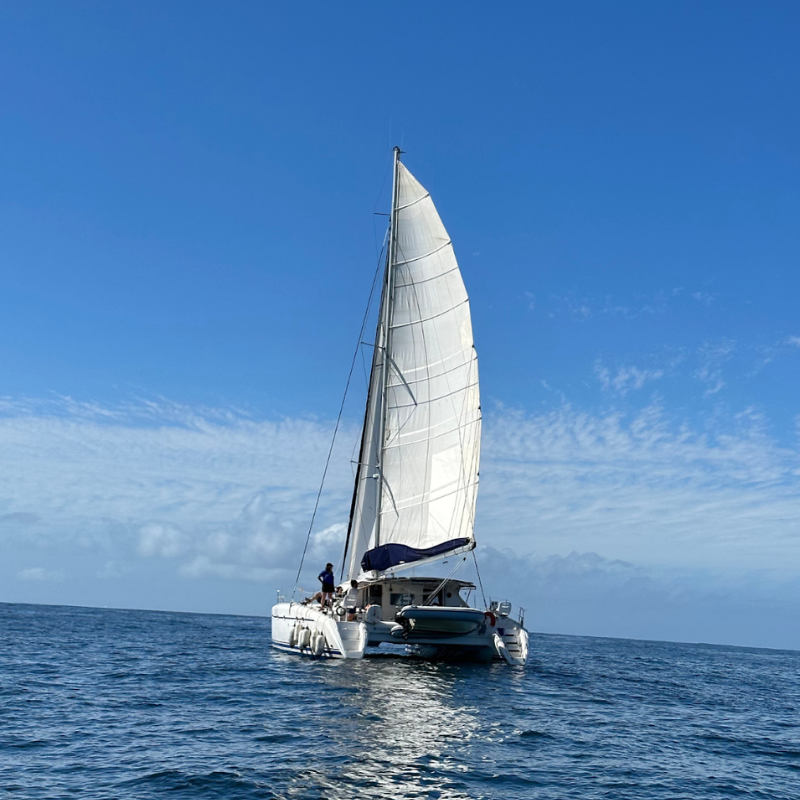
End-of-life autonomous floats
Imagine thousands of silent sentinels scattered across the globe. For over 25 years, the international Argo program’s autonomous profilers have been probing our oceans, diving up to 6,000 meters deep to measure essential variables like temperature, salinity, and oxygen. These Argo floats are vital for understanding our climate, yet they share a tragic fate: once their batteries run dry after 4 to 7 years of service, they are usually abandoned to the ocean floor.
This represents both a loss of advanced technology and a source of pollution that the scientific community could no longer ignore. Thus, thanks to IFREMER and EURO ARGO, the NAARCO* campaign (North Atlantic Argo Recovery Cruise Operation) was born, driven by a bold ambition: to recover these robots under sail between Brest and the Azores to minimize the carbon footprint.
To achieve this, the mission required a vessel, the catamaran Morskoul, operated by the cooperative Skravik, and navigation intelligence to guide it. This is where the adventure intersects with D-ICE Engineering.
The challenge: finding a needle in a moving haystack
Recovering an Argo float is no simple pleasure cruise. Unlike a motor vessel that can power directly toward a target, a sailboat is at the mercy of the wind. The constraints were immense:
- Tight Timing: The boat’s arrival had to be perfectly synchronized with the float’s ascent, as the robots only surface briefly to transmit data.
- Daylight Only: Recovery operations had to take place during the day.
- "Low-Tech" Ingenuity: Without heavy cranes, the crew had to innovate. They developed a custom "lasso" system with a slip knot to manually catch and lift the floats from the back of the catamaran.
For the Skravik crew, preparation and decision support were critical.
Preparation: simulation before navigation
Long before leaving the port of Brest in mid-May, the mission began in D-ICE’s offices. We precisely defined the speed polars of the Morskoul to model its specific behavior under sail.
Through a massive statistical study covering 10 years of historical weather data and 684 simulated departures, we were able to estimate the optimal route to connect the 10 target floats. This analysis identified the ideal weather window and estimated the total duration of the campaign.
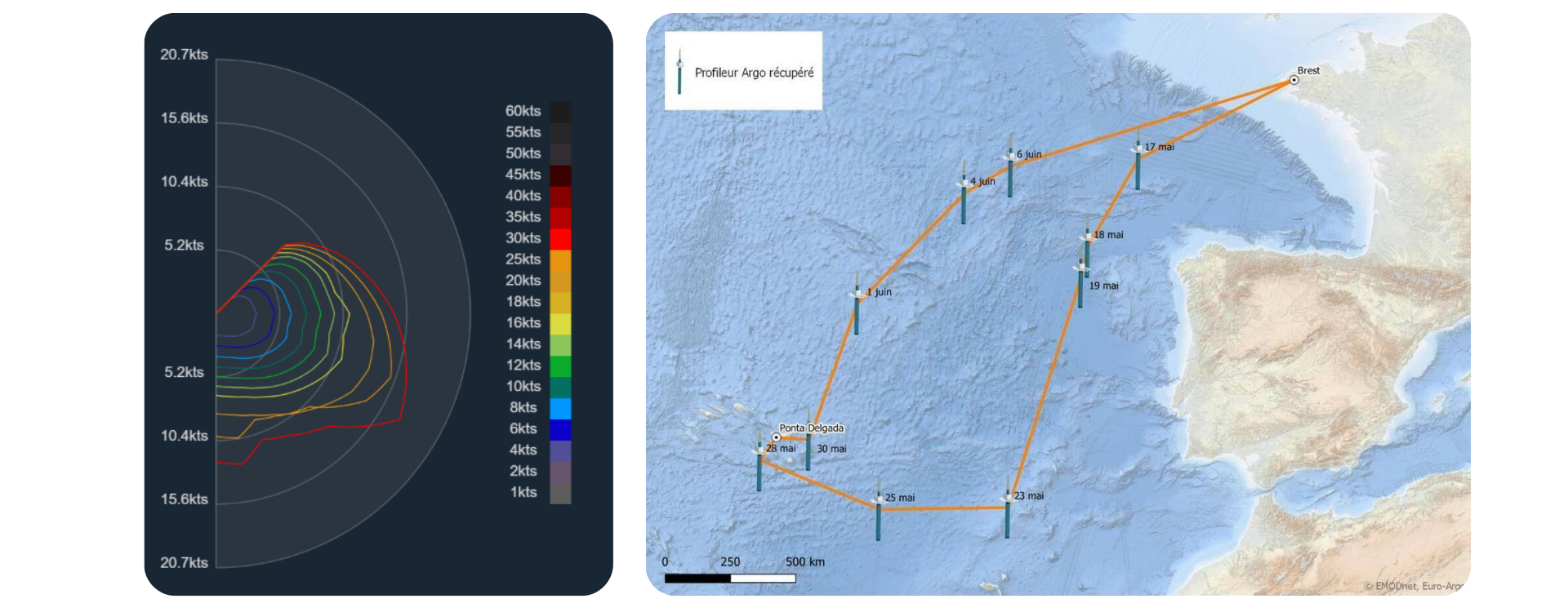
At sea: Squid X at the helm
Once at sea, the crew was not alone. They were equipped with our Squid X software.
Every day on board, weather analysis was in full swing. By comparing over 10 different wind models directly within the software, the crew could validate their navigation plan. D-ICE’s routing technology allowed them to align their Estimated Times of Arrival (ETAs) with the surfacing windows of the robots, enabling perfect synchronization with the onshore teams controlling the profilers.
Laura Troudet, Director of Skravik and co-skipper of the mission, highlights the importance of this strategic support:
“Squid X supported us throughout the expedition. We were able to refine our polars, plan our arrivals at each float, anticipate weather conditions and avoid a major depression on the return from the Azores thanks to Best-Start.”
The software's efficiency shone where it mattered most: digital sobriety. Because the heavy calculations were performed onshore by D-ICE, data exchanges via satellite weighed only a few kilobytes.
Mission Accomplished
On June 10, 2024, after 27 days at sea, the Morskoul returned to Brest with a full hold. The outcome is a victory for sustainable oceanography. The crew recovered 10 Argo floats and redeployed 6 others.
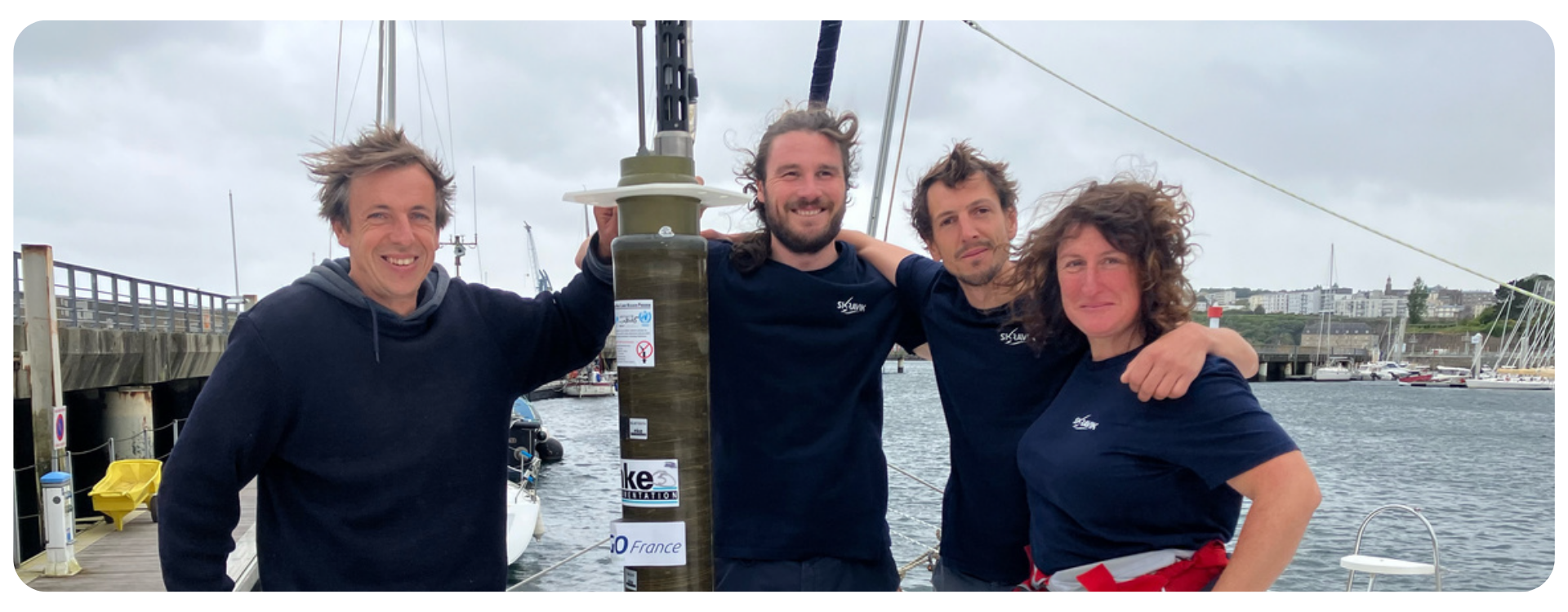
The recovered instruments were in surprisingly good condition.
"We’re hopeful that, by changing the batteries and some other parts, we’ll be able to redeploy them again," said Romain Cancouët, Operational Engineer at Euro-Argo ERIC. He summarizes the scale of this success: “Recovering 10 floats is not insignificant; it represents the annual contribution of a country like Norway to the Argo program.”
All of this was achieved with a negligible consumption of just 500 liters of diesel, whereas a standard offshore motor vessel would have burned 1,000 liters per day.
This mission paves the way for a new era: partners are now hoping to scale up, aiming to recover 25% to 50% of end-of-life floats in the future.
For Maxime Dupuy, Head of Weather Routing at D-ICE, this mission has a special resonance: “By supporting Skravik and the NAARCO campaign, the loop is closed! Indeed, our know-how and weather routing solutions rely heavily on the data collected by the Argo program.”
At D-ICE, we are proud to have put our expertise at the service of cleaner navigation and more sustainable science.
---
*NAARCO was funded by the European GEORGE (Next Generation Multiplatform Ocean Observing Technologies for Research Infrastructures) project, which aims to develop future generations of marine observation instruments.


