
Weather as a strategic operational risk
When a voyage meets a fast-intensifying storm, the difference between disruption and performance lies in anticipation. During the New York - Colón transit (21–28 October 2025), Le Boréal, a PONANT EXPLORATIONS cruise vessel, encountered a developing low-pressure system that would soon become Hurricane Melissa. What began as a routine passage rapidly evolved into a real-world test of preparedness, decision support and voyage optimisation.
In today’s maritime environment, weather is no longer a background variable; it is a defining factor in operational reliability. Allianz’s Safety & Shipping Review reports that nearly 70% of maritime incidents are weather-related, while Drewry estimates that unexpected weather disruptions cost the global shipping industry $2–3B per year. For cruise operators, the impacts extend beyond fuel and schedules: passenger comfort, safety and service continuity are equally critical.
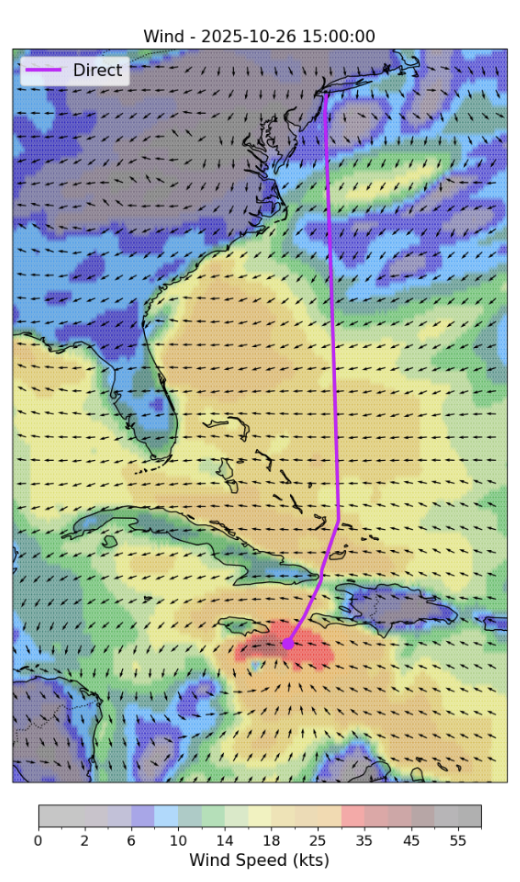
Initial conditions: a routine departure with an emerging signal
At departure on October 21, weather conditions appeared largely manageable. Moderate head winds (~20 kt), a 2 m sea state, and favourable Gulf Stream currents provided a stable environment for the initial routing plan.
However, early observations highlighted a developing low-pressure system forming in the wider region. At this stage, the system was neither intense nor organised. Still, the D-ICE operations team flagged it for continuous monitoring, a decision that would prove essential only days later.
The Turning Point: a low-pressure system intensifies into Hurricane Melissa
Within 48 hours, the situation shifted strongly. By October 24, multiple high-resolution weather models indicated the formation of a deepening low-pressure system into Hurricane Melissa, but exhibited notable divergence in its trajectory and position. Monitoring the evolution carefully helped to adapt safely Le Boréal's route.
The post-voyage analysis illustrates how model divergence gave way to rapid alignment as Melissa intensified. The direct route now faced the possibility of:
- wind speeds exceeding 70 knots,
- wave heights reaching up to 9 metres of Hmax,
- severe cross-sea conditions,
- reduced comfort,
- increased operational stress on the vessel.
For a cruise vessel, this combination represents a significant risk to both safety and service quality. Maintaining schedule integrity while protecting passenger experience was central to the decision-making process.
Scenario planning: 3 routing options generated by TACTiCS
To support the Captain’s decision, D-ICE generated three routing scenarios using TACTiCS. Each scenario balanced safety, ETA requirements and fuel efficiency.
- Direct Route (Great Circle) : the shortest path in theory, but now directly exposed to Melissa’s core. Severe weather and operational risk made this option unsuitable.
- Central Corridor Route (CCR) : a route passing between Haiti and Cuba, then west of Jamaica. Less exposed depending on the hurricane’s evolution, but model-dependent.
- Western Avoidance Route : a longer track bypassing Melissa from the west. Offers the lowest weather exposure and the highest stability, at the cost of increased distance and potential ETA adjustment.
After reviewing model updates, the Captain selected the western avoidance option, prioritising safety while preserving operational efficiency.
“The TACTiCS software and the shore-based support provided by D-ICE proved particularly valuable. Being able to analyse Hurricane Melissa’s evolution across several weather models, even when they diverged, was a key element in our decision-making.” Captain Mickael Debien of Le Boréal
The navigated route: avoiding Melissa from the west
Le Boréal did not simply deviate from the storm, it accelerated in time to pass north of Jamaica before conditions worsened. This strategic deviation delivered robust operational benefits:
- maximum wind exposure reduced from 40+ kt to ~25 kt,
- waves HS reduced down to ~3 m,
- improved lateral stability,
- calmer conditions throughout the transit.
“This approach allowed us to anticipate early enough and adjust our route by increasing speed, so we could pass north of Jamaica before conditions deteriorated. The transit unfolded in excellent conditions, and we were able to manage this critical situation with greater confidence thanks to the quality of the tools and the support provided.”
Captain Mickael Debien of le Boréal
Post-Voyage Analysis: quantifying the performance gains
Once Le Boréal reached Colón, our team conducted a full post-voyage reconstruction to understand what the chosen route truly delivered. The idea behind this exercise is simple: take the actual route and compare it with two reference scenarios, the theoretical great-circle track and the optimised path reconstructed with perfect hindsight and reanalysed weather fields.
The results speak clearly. Following the direct route would have forced the vessel into the heart of Melissa’s circulation, generating higher resistance, heavier seas and consequently higher consumption. The navigated track, by contrast, avoided these energy-intensive zones and reduced weather-induced engine loads. Over the course of the voyage, this translated into approximately 5,2 tonnes of fuel saved compared with the great-circle baseline, a reduction of about 4%. These numbers are consistent with what international studies report: according to the IMO, weather-optimised routing typically yields 2–10% fuel savings, placing Le Boréal’s performance right within the expected upper range.
TACTiCS in action
PONANT EXPLORATIONS’s entire fleet is equipped with TACTiCS, and every new Captain receives a personalised onboarding session. The operational team at D-ICE monitors early transits and maintains open communication channels during periods of heightened weather risk. This collaborative approach strengthens decision-making and contributes to a safer, more efficient fleet.
TACTiCS supports:
- voyage preparation and briefings before departure,
- continuous monitoring when conditions evolve,
- real-time routing suggestions from shore,
- ETA and speed optimisation,
- post-voyage analytics to refine vessel models and performance curves.


